The program INT-26-2a, "Recommended Values for Neutrinoless Double-Beta Decay Nuclear Matrix Elements" is now available
News and Announcements
Image
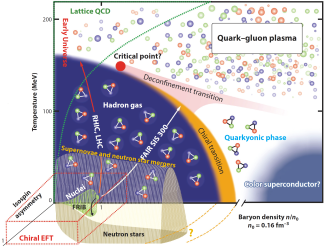
The "Finite-Temperature Effects in Multi-Messenger Astrophysics" workshop takes place June 15-19, 2026. Visit the workshop webpage for more information on the event.
Image
The "Nuclear Hamiltonians for Advancing Nuclear Physics and Beyond" program takes place April 27 - May 29, 2026. Visit the program webpage for more information on the event.
Image
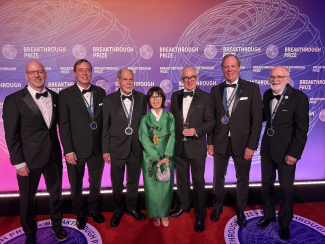
Dave Hertzog, director of CENPA at the the UW and co-spokesperson for the Muon g-2 experiment, accepted the Breakthrough Prize for Fundamental Physics on behalf of the g-2 collaborations.
More information on this achievement can be found at the links below:
https://www.nature.com/articles/d41586-026-01014-9
https://breakthroughprize.org/Laureates/1
Image Credit: At the Breakthrough Prize ceremony on April 18, 2026, left to right: Brookhaven National Laboratory Interim Director John Hill, Fermi National Accelerator Laboratory (Fermilab) physicist Chris Polly, Boston University physicist Lee Roberts, Fermilab Director Emeritus Young-Kee Kim, CERN Director General Mark Thomson, University of Washington physicist David Hertzog, and Brookhaven Lab physicist William Morse. (Courtesy of Kat Morse)
Image
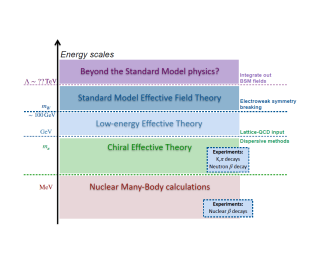
The workshop "Testing the Standard Model in Charged-Weak Decays" took place at the INT from January 12- 16.
38 participants were in attendance. Read the workshop highlights report here.