
Probing the Axial Form Factor: An Emerging Frontier
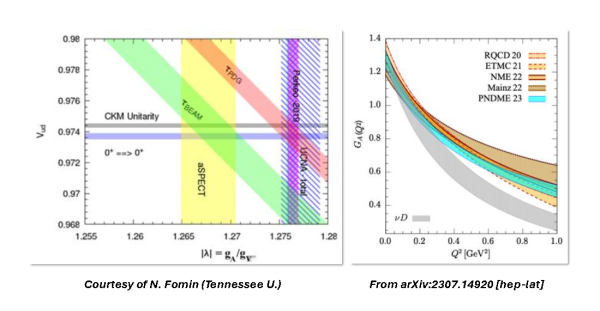
Event ID: INT-26-97W
Note: This is an in-person workshop.
OVERVIEW
This workshop aims to advance ongoing efforts to identify and characterize the impact of a potential high-precision measurement of the nucleon axial form factor, and to explore its broad implications for nuclear theory, lattice QCD, neutrino physics, and beyond. By bringing together experts across these communities, the workshop will provide a focused forum to enable future progress, both theoretical and experimental, in pinning down the axial form factor and its utilization in the broader neutrino and related experiments.
A major emphasis will be on emerging measurement opportunities at Jefferson Lab using polarized electron and positron beams to probe the axial structure of the nucleon. These new concepts, together with rapidly improving lattice QCD calculations, make this a uniquely timely moment to gather the community. The workshop is designed to strengthen collaboration between experimentalists and theorists, ensuring that upcoming measurements are optimized and that theoretical advances inform experimental strategy. Constraining the axial form factor is also essential for the success of next-generation neutrino experiments including DUNE and Hyper-K as they move toward construction and operation.
The primary goal of the workshop is to create an environment that stimulates discussion, collaboration, and the development of new techniques for high-precision determination of the axial form factor. By engaging both senior and junior researchers, the meeting aims to deepen our understanding of the interplay between nuclear, LQCD, neutrino physics, and beyond. A key outcome will be the formation of new collaborations across theory and experiment that can drive progress in this rapidly evolving area.
Note: A workshop registration fee may apply.