The Quantum Physics of Stars
Event ID: INT-26-2b
Note: This is an in‑person workshop. However, if you are unable to attend in person, virtual participation may be accommodated on a case‑by‑case basis.
Attention: This event was originally scheduled as a 2-week event from Aug 17 - 28. It has been shortened to a 1-week workshop from Aug 17 - 22.
A workshop registration fee may apply.
OVERVIEW
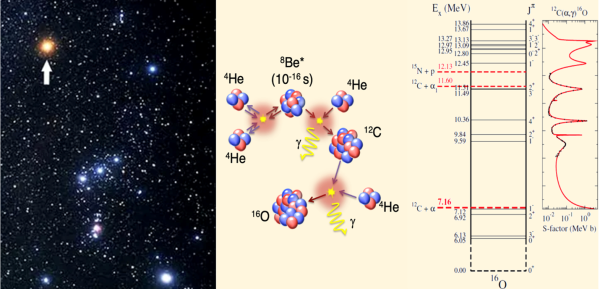
The different burning phases of stars are determined by nuclear reaction rates, which in turn depend on the quantum structure of the underlying nuclear systems near the reaction thresholds and on the relevant reaction mechanisms. Only a small subset of key reactions has been measured at the temperatures found in stellar plasmas. The same limitation applies to more dynamic astrophysical sites, from the Big Bang to stellar explosions. Consequently, most reaction rates are obtained from theoretical extrapolations. Discrepancies between the astrophysical predictions based on these extrapolated rates and observed stellar signatures have been reported, and many may be linked to low-energy or near-threshold quantum effects. Understanding these effects is essential for reliable modeling of nuclear reaction processes, not only in stars but also in low-temperature plasma environments, such as magnetic and inertial confinement fusion systems, which operate in similar temperature regimes.
The goal of this workshop is to bring together experts from the nuclear astrophysics (NAP), nuclear reaction physics (NRP), and nuclear plasma physics (NPP) communities, on both the experimental and theoretical sides, to discuss quantum phenomena associated with the emergence of single-particle and cluster configurations near particle thresholds and their impact on nuclear reaction and fusion processes in stars. The workshop will focus on the underlying quantum physics that dictates nuclear reaction and fusion cross sections at threshold, including the coupling of bound states to the continuum, interference between direct and resonant mechanisms, and dynamical effects occurring during the merging of heavier nuclei in fusion. A key objective is to understand the nuclear structure effects that drive these phenomena and to identify strategies for incorporating them consistently into modern reaction theory models and simulations of nuclear reaction cross sections.
In particular, we plan to focus our discussions on the following topics:
- Ab-initio reaction theory and halo/cluster effective field theory
- Threshold aligned states in proton, neutron, and α induced reactions
- R-matrix phenomenology
- Accelerator and inertial confinement fusion data
- From asymptotic normalization coefficient to trojan horse method.