
Recommended Values for Neutrinoless Double-Beta Decay Nuclear Matrix Elements
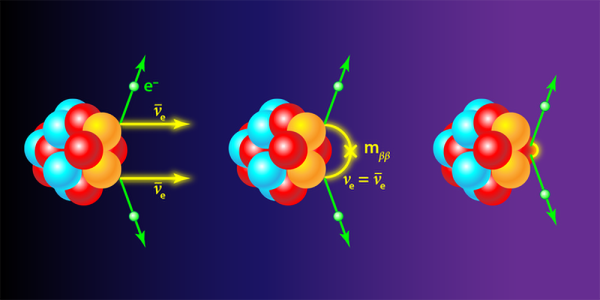
Event ID: INT-26-2a
Embedded Workshop Week: July 20 - 24, 2026 - A registration fee for the embedded workshop week may apply.
Note: This is an in-person program.
Neutrinoless double beta (0νββ) decay is a powerful experimental probe of the nature of neutrino masses and the origins of the baryon asymmetry in our universe; two of the most significant open questions in fundamental physics. In recent years, experiments have achieved dramatic gains in sensitivity to this process, and the future is bright: multiple experimental techniques are poised to deploy 100’s to 1000’s of kilograms of isotopic mass, reaching sensitivities that probe important new parameter space. This program was highlighted in the 2023 NSAC Long Range Plan for Nuclear Science as a top priority for nuclear physics, and the next decade will see a ramp-up of effort in this program, with the potential for a discovery to come at any time.
The nuclear theory that connects the experimental observable – the 0νββ decay half-life – to beyond-the-standard-model (BSM) physics is a crucial part of this effort. This theory is used to calculate the transition nuclear matrix elements (NMEs) which require both a) solving the nuclear many-body problem to construct reliable nuclear Hamiltonians, and b) connecting the BSM physics (which operates at high energy scales) to low-energy operators relevant for nuclear transitions. Turning 0νββ decay half-life measurements into deductions on the BSM physics of interest – the underlying mediating mechanism and its parameters – will require not only robust NME values but also properly characterized uncertainties, including their correlations among different isotopes. To date, NME calculations have used a wide variety of nuclear models and have produced results with large variations and largely without the difficult-to-quantify theoretical uncertainties, making it difficult to directly compare experimental results with theory or with each other.
Two main advances have improved the reliability of 0νββ NMEs in the last ~five years. First, the identification of a leading-order contact term has opened a new line of inquiry, as this NME component, previously thought to be small (about 10% effect), turned out to have a contribution of 50% or more in particular nuclei. Second, the application of ab initio methods using chiral effective field theory (EFT), instead of phenomenological nuclear Hamiltonians, has changed the landscape of NME calculations. Ab initio many-body methods are systematically improvable, as are the input chiral Hamiltonians, and if they manage to reproduce key nuclear structure observables relevant for 0νββ decay, their NME predictions can be considered more controlled than the usual ones from phenomenological methods, which rely on inconsistent nuclear states and 0νββ operators. Remarkably, ab initio calculations have recently shown that with these approaches, there is no need to invoke an ad hoc quenching of the axial coupling gA to reproduce β decay nuclear matrix elements.
Given the rapid theoretical progress in this field, and the prospect of discovery-class experiments producing new results in the near future, it is time to bring together the theory community to generate reliable “recommended” NMEs for each isotope of experimental interest, as well as to lay the groundwork for continued improvement and refinement of these quantities as further progress is made.
This program will provide a forum for discussing the key aspects of this problem:
- Solving the nuclear many-body problem
- Connecting high-energy physics to low-energy operators
- Quantifying and propagating uncertainties
The key goal will be to produce a white paper that provides the community with suggested NMEs and uncertainties, describing the methodology for producing these values and a path forward for systematic improvement and uncertainty reduction.
Program format
The INT program will have the structure outlined below.
Week 1: Many-Body Methods – Ab Initio and Phenomenological. Discussion of the nuclear structure physics relevant for understanding 0νββ decay.
Week 2: Double Beta Decay Operators and the Contact Term. Discussion of the physics connecting the nuclear decay to lepton-number-violating physics.
Week 3: Uncertainty Quantification. Discussion of sources of uncertainty and error propagation.
Week 4: Workshop and Recommendation Development – “Toward Recommended Values for Neutrinoless Double Beta Decay Nuclear Matrix Elements”. Workshop to engage the larger community, including experimentalists, in the process of producing reliable and community-vetted NME values. Will include the drafting of a whitepaper summarizing results from the program to disseminate the first community-vetted NME values, and development of a plan for their stewardship into the future.