Hybridizing Neural Quantum State and Diffusion Monte Carlo Approaches to Quantum Many-Body Systems
Junior Mentor:
Garrett King (INSPIRE-HEP, email: kinggar@uw.edu)
Senior Mentor:
Daniel Hackett (INSPIRE-HEP, email: danhack@uw.edu)
Prerequisites:
Familiarity with Python or other modern programming languages; quantum mechanics.
What Students Will Learn:
In this project, a student can expect to learn about variational and diffusion Monte Carlo approaches to the quantum many-body problem. The student will also gain familiarity with machine learning libraries that will be explored in this work (ex: PyTorch, TensorFlow, and/or Equinox).
Expected Project Length:
9 months
Project Description:
At the heart of studying nuclear structure is an attempt to describe a nucleus in terms of its relevant degrees of freedom at low-energies. With the advent of low-energy effective interactions derived from the underlying theory of quantum chromodynamics and the development of novel many-body techniques, calculations of nuclei in terms of proton and neutron degrees of freedom in medium-mass nuclei have become possible [1]; however, a desire to treat short- and long-range correlations on equal footing in calculations in many-body calculations of medium-mass nuclei has recently motivated the use of quantum Monte Carlo [2] methods combined with neural networks to construct neural quantum states (NQS) [3,4] for these systems.
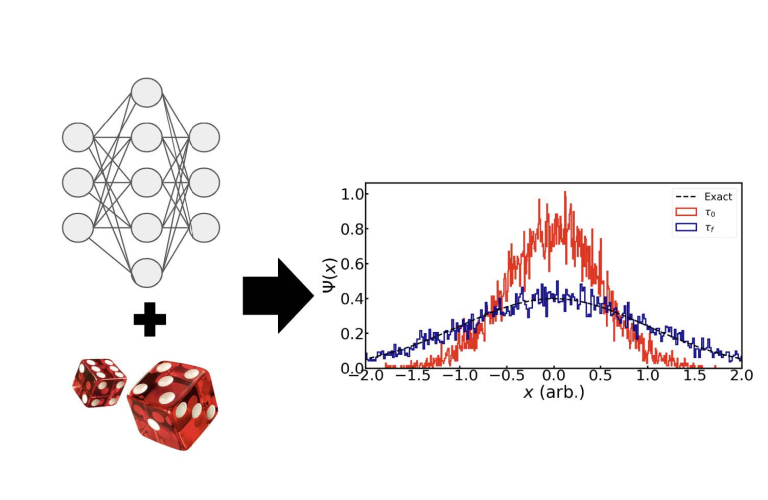
Typically, the NQS is used as an ansatz for a trial wave function in the variational Monte Carlo approach, which is guaranteed to give an upper bound to the true ground state energy. In this project, we would like to explore building an NQS ansatz for a simple two-particle model, and then using this trial wave function as an input to diffusion Monte Carlo (DMC) simulations. While DMC is in principle exact, in practice it is hampered by the Monte Carlo sign problem when working with fermions. Strategies to mitigate the sign problem make your final result dependent on a guiding wave function (typically, a VMC computation). In this project, a student will investigate how to build and variationally optimize an NQS, as well as how to use this as an input to DMC simulations.
References:
- H. Hergert, Front. Phys 8 (2020)
- J. Carlson et al., Rev. Mod. Phys. 87, 1067 (2015)
- Y. Yamauchi et al., arXiv:2609.20799
- B. Fore et al., arXiv:2607.09223
Breakdown of expected timeframe:
- 1 month – review QMC and NQS
- 1 month – apply VMC basics and learn AI/ML libraries
- 2 months – Develop NQS’s for para- and ortho-helium
- 3 months – Implement a diffusion MC algorithm starting from traditional VMC and NQS ansatz
- 3 months – Study 2H and 4He using NQS and VMC ansatz as input to DMC with Minnesota and/or pionless EFT potentials