
Electroweak Transitions in Two-Nucleon Quantum Mechanics
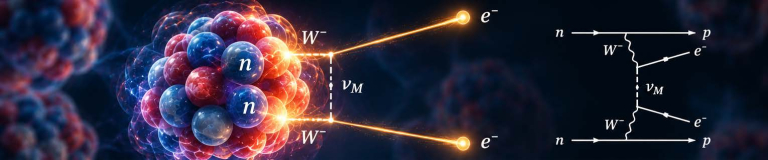
Artistic illustration of neutrinoless double beta decay, a theoretically feasible but as yet experimentally unobserved weak nuclear transition that may shed light on the nature of the neutrino and physics beyond the Standard Model.
Junior Mentor:
Mark D'Souza (email: mkdsouza@uw.edu)
Faculty Mentors:
Vincenzo Cirigliano (email: cirigv@uw.edu)
Wouter Dekens (email: wdekens@uw.edu)
Prerequisites:
Basic knowledge of quantum mechanics and basic (numerical) programming skills (e.g., in Python, Mathematica, etc.).
What Students Will Learn:
The student will learn how quantum mechanics is used to describe interactions between nucleons (protons and neutrons), nuclear bound states and scattering processes. The student will develop numerical methods for solving the Schrödinger equation and computing nuclear transition matrix elements relevant to ordinary beta decay and neutrinoless double-beta decay. The project will also introduce the principles of effective field theory and renormalization, with particular emphasis on understanding how short-distance nuclear interactions affect physical predictions.
Expected Project Length:
6-12 months
Project Description:
Beta decay is a fundamental process in nuclear physics in which a neutron is converted into a proton through the weak interaction. An especially interesting related process is neutrinoless double-beta decay, in which two neutrons are converted into two protons and two electrons are emitted without accompanying neutrinos. Observation of this process would establish that lepton number is not conserved and could provide important insights into the nature of neutrino masses as well as if it is its own antiparticle (the Majorana neutrino hypothesis).
Accurate theoretical predictions for these processes require an understanding of how nucleons interact inside nuclei and how they respond to the weak force. At low energies, nucleons can be described using quantum mechanics, with their interactions represented by nuclear potentials that are determined in a systematic framework known as Effective Field Theory (EFT). These potentials determine the nuclear wave functions, which can then be used to calculate transition probabilities.
An important challenge in nuclear theory is understanding how physical predictions depend on the short-distance behavior of nuclear interactions. In this project, we will begin by numerically solving the Schrödinger equation with a Yukawa potential, which models the exchange of a virtual pion between nucleons, and supplement it with a short-range delta-function interaction motivated by EFT. The strength of this contact interaction will be adjusted as the regulator is varied to reproduce the experimental nucleon–nucleon scattering length. We will then investigate whether other observables (e.g. phase shifts, bound state properties) remain independent of this arbitrary regulator, a requirement known as renormalization group invariance. If this invariance is not preserved, additional operators from the EFT must be incorporated. Having established RG invariance for the nuclear interaction, we will separately investigate this procedure for the weak transition operators relevant to beta decay and neutrinoless double-beta decay.
The project will provide experience in computational quantum mechanics while introducing important open questions in modern nuclear theory. Depending on progress, the methods developed may be extended to more realistic nuclear interactions and contribute to ongoing research on the theoretical description of nuclear beta decay.