
Topics in Heavy Element Nucleosynthesis
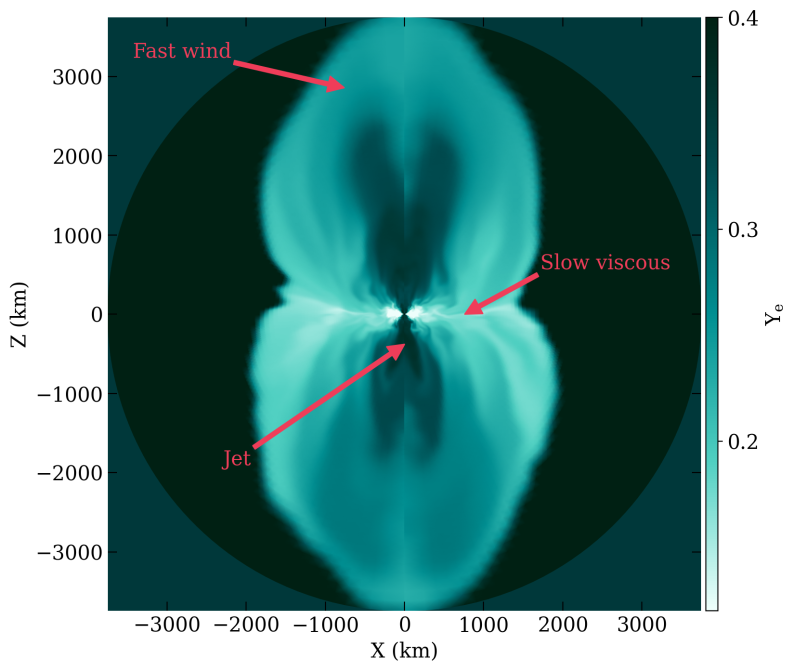
can occur (from [1]).
Student:
Noah Hayden
Mentors:
Kelsey Lund (INSPIRE-HEP, email: klund6@uw.edu)
Prerequisites:
None.
What Students Will Learn:
If the student is not familiar with Python, they can learn Python for the purposes of data analysis and visualization. The project will focus on the interplay between nuclear physics and astrophysics, and will focus on a survey of current literature. The student will learn how to identify and interpret nuclear abundances and stellar data from the literature, and become familiar with nucleosynthesis calculations for r-process.
Expected Project Length:
At least 2 terms.
Project Description:
The rapid neutron capture process (r-process) is the nucleosynthetic process responsible for the creation of roughly half the material in the universe heavier than iron. In particular, the r-process is the only natural mechanism via which actinides, such as thorium, plutonium, and uranium, can be produced.
Making predictions for whether r-process nucleosynthesis can occur in an event, whether it be a corecollapse supernova or a neutron star merger, requires solving nuclear physics problems in the context of complex astrophysical systems.This involves, for example, the unknown properties of heavy radioactive nuclei, modeling turbulent outflows, understanding galactic chemical evolution models, and more.
In this project, the student will survey current approaches to these different problems and learn about different modern techniques used in nucleosynthesis and nuclear astrophysics studies.
References:
[1] K. A. Lund, P. Mukhopadhyay, J. M. Miller, and G. C. McLaughlin. Angle-dependent in situ fast flavor transformations in postneutron-star-merger disks. The Astrophysical Journal Letters, 985(1):L9, may 2025.