Finite-Temperature Effects in Multi-Messenger Astrophysics
Samuel Novario
Event ID: INT-26-96W
Note: This is a "hybrid" workshop, meaning there will be a combination of virtual and in-person participants.
OVERVIEW
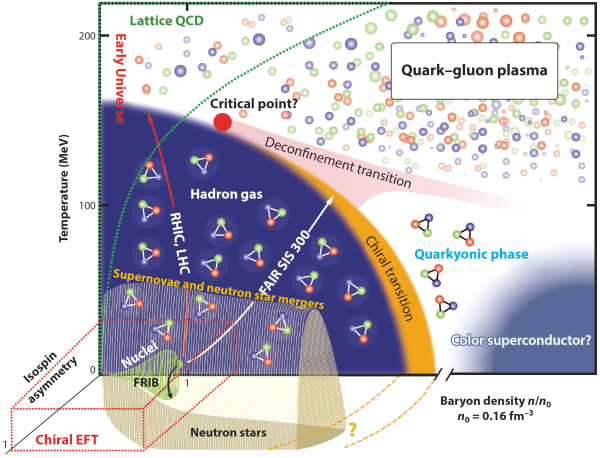
Understanding the properties of nucleonic matter at finite temperatures is essential for explaining the physics behind explosive astrophysical phenomena like core-collapse supernovae (CCSNe), the resulting proto-neutron stars (PNS), and neutron star mergers (NSM). These extreme events are not only critical to the evolution of the universe but are also likely sites for rapid neutron-capture (r-process) nucleosynthesis, which is responsible for forming many of the heaviest elements. In the context of multi-messenger astrophysics, these events are particularly significant as they generate electromagnetic, gravitational-wave, and neutrino signals, providing a comprehensive view of the underlying processes. While significant progress has been made in simulating these events , a comprehensive understanding of the underlying thermal effects is an ongoing endeavor.
Much work has already been completed on the structure of neutron stars as well as the formation and inspiral dynamics of binary neutron stars (BNS) where the matter is treated as cold and in beta-equilibrium. Specifically, gravitational waves (GW) observations are useful in constraining the tidal deformability and radii of the constituent stars, while x-ray observations are useful in constraining the compactness. These results can then constrain the zero-temperature equation of state (EOS) and thus their underlying internucleon interactions.
However, in the post-merger phase, as in the cases of CCSNe and PNS, the dense matter must be treated as finite-temperature systems, where temperatures can reach above 50 MeV. These high temperatures can influence the EOS, neutrino emission, and the formation of accretion disks and ejecta. Therefore, treatment of these thermal effects can lead to uncertainties in predicting observable quantities, including gravitational wave and electromagnetic signals. While current gravitational wave detectors cannot capture the behavior of the post-merger remnant directly, next-generation detectors like the Cosmic Explorer and the Einstein Telescope will meet that challenge.
This workshop will help to bridge the gap between current astrophysical simulations and the complex thermal physics that governs these extreme environments by bringing together experts in computational astrophysics, nuclear physics, and observational astronomy to explore the impact of finite temperatures in explosive multi-messenger phenomena. The program will be composed of four main areas of focus:
- Finite-temperature Equations of State
- Ejecta and Nucleosynthesis
- Astrophysical and Experimental Constraints
- Merger Simulations
GOALS
A proper understanding of finite-temperature effects is crucial for the interpretation of experimental observations that are expected in the very near future. LIGO's fifth observing run is scheduled to start in 2027, the Vera Rubin observatory is set to begin operations in 2025 and next-generation gravitational wave detectors like the Einstein Telescope and Cosmic Explorer are expected to come online in the mid-2030s. It is therefore important that the involved scientific communities come together to work towards a theoretical framework to better understand of the upcoming wealth of experimental data.
The primary goal of this workshop will be to bring together experts from diverse physics backgrounds, as well as various career stages, to discuss recent progress and challenges concerning multi-physics problems associated with finite-temperature effects in multi-messenger astrophysical events, including but not limited to:
- Understanding and quantifying uncertainties associated with common approximations to finite-temperature EOSs.
- Identifying potential observable signatures of finite-temperature effects in anticipation of ongoing and future astronomical and experimental campaigns, including Cosmic Explorer, LIGO O5, and heavy-ion collisions.
- Outlining sensitivities in downstream simulations and calculations as well as implications for predictions of observable signatures.
- Recognizing the requirements of simulations to reliably incorporate finite-temperature EOS effects.
Note: A workshop registration fee may apply.