
Neutrinoless Double Beta Decay with Sterile Neutrinos
Mentor:
Vaisakh Plakkot (INSPIRE-HEP, email: vplakkot@uw.edu)
Prerequisites:
Some knowledge of particle physics and programming skills (Python) would be helpful.
What Students Will Learn:
The focus of the project will be on neutrinoless double beta decays. On the way, the student will learn about beta decays and double beta decays, effective field theory methods, beyond-the-Standard Model physics, and techniques and tools available for the computation of neutrinoless double beta decay rates.
Expected Project Length:
8-12 months
Project Description:
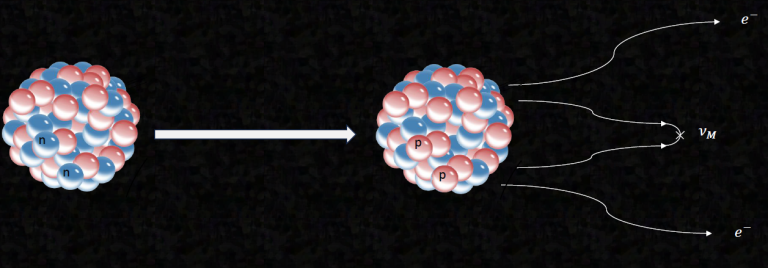
If neutrinos are their own antiparticles, that is, they are Majorana fermions, unique phenomenological signals such as neutrinoless double beta decay can arise. This property of neutrinos may be brought on by the presence of particles beyond the Standard Model (SM), such as "sterile" neutrinos. Their presence can have rich phenomenological implications beyond neutrinoless double beta decays and other lepton-number-violating signals, and they can also provide an explanation to the observed masses of the SM neutrinos. The decay rate for the hypothetical process of neutrinoless double beta decay has been studied in effective field theory frameworks [e.g., 1], and has been extended to allow for the possibility of light sterile neutrinos also mediating the process [2,3]. This project aims to make use of the software package $\nu$DoBe [4] to study the phenomenology of different models beyond the SM, and if time permits, to complement or extend the $\nu$DoBe package by implementing the light sterile neutrino exchange mechanism in the framework.
References:
[1] Cirigliano et al. A neutrinoless double beta decay master formula from effective field theory. JHEP 12 (2018) 097.
[2] Dekens et al. Neutrinoless double-beta decay in the neutrino-extended Standard Model. Phys. Rev. C 108 (2023) 4, 045501.
[3] Dekens et al. Neutrinoless double beta decay rates in the presence of light sterile neutrinos. JHEP 09 (2024) 201
[4] Scholer et al. νDoBe -- A Python Tool for Neutrinoless Double Beta Decay. JHEP 08 (2023) 043.