Nuclear Shell Structure with Quarkyonic Phase Space Constraints
Student:
Osha Higgs
Mentor:
Tianqi Zhao (INSPIRE-HEP, email: tianqi24@uw.edu)
Prerequisites:
Quantum mechanics, Linear Algebra, and Calculus are necessary. Scientific programming in Python is preferred.
What Students Will Learn:
The student will gain understanding of the nuclear shell model and the Woods–Saxon mean field potential, learn how single-particle nuclear problems can be formulated and solved in momentum space, and develop intuition for the role of momentum distributions and phase space in many-body quantum systems. The student will acquire practical experience using phenomenological regulators to model underlying microscopic constraints, implement numerical methods for solving integral eigenvalue problems, and perform parameter optimization by fitting theoretical models to experimental nuclear observables. Through this process, the student will also develop strong scientific coding skills in Python or a similar language, including linear algebra and data visualization.
Expected Project Length:
Two quarters
Project Description:
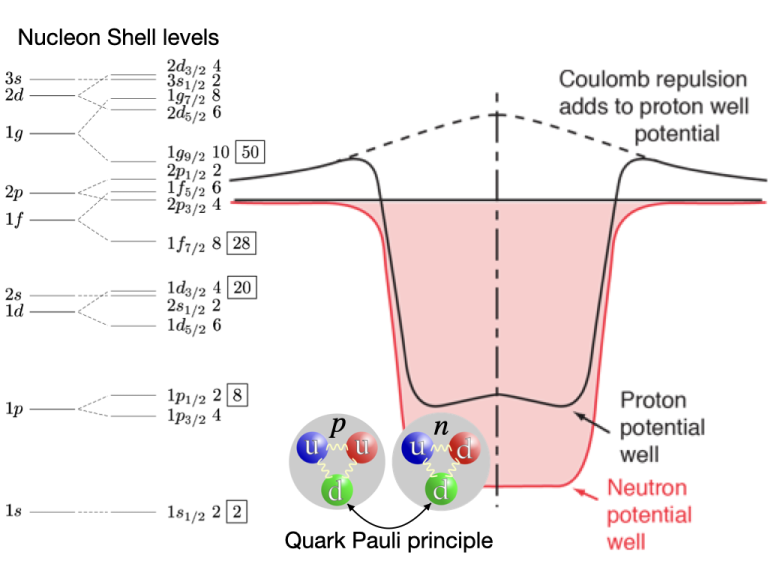
The nuclear shell model successfully describes single particle structure in finite nuclei using phenomenological mean field potentials such as the Woods–Saxon potential. Recent work has suggested that nuclear matter near saturation density may already be close to saturating quark phase space, potentially leading to a depletion of low momentum nucleon states. In particular, quarkyonic models predict strong low momentum suppression in nuclear matter [1], the quark Pauli principle implies that such effects may become relevant already at nuclear densities [2], and extensions to finite nuclei indicate that similar momentum space suppression could persist in heavy nuclei [3]. These results motivate a direct test of whether conventional nuclear shell structure can accommodate quarkyonic-inspired modifications of low momentum nucleon modes.
In this project, we will address this question using a controlled and transparent shell-model framework. Starting from the standard Woods–Saxon single particle Hamiltonian, we will reformulate the shell model problem in momentum space and introduce a smooth regulator that suppresses low momentum components of the nuclear wave functions, phenomenologically mimicking the effect of quark phase space saturation while remaining entirely within a nucleonic description. We will solve the resulting momentum-space eigenvalue problem numerically and refit Woods–Saxon parameters to selected double-magic nuclei with and without the regulator. By comparing optimized potentials, single particle spectra, and wave function properties, we will assess whether quarkyonic-inspired low momentum suppression can be absorbed into conventional mean field parameters or whether it leads to observable tensions with established nuclear shell structure.
References:
[1] Koch, V., McLerran, L., Miller, G.A., Vovchenko, V., 2024. Examining the possibility that normal nuclear matter is quarkyonic. Physical Review C, 110(2), p.025201.
[2] McLerran, L., Miller, G.A., 2024. Quark Pauli principle and the transmutation of nuclear matter. Physical Review C, 110(4), p.045203.
[3] Nikolakopoulos, A., Miller, G.A., 2025. Quark phase space distributions in nuclei. Physical Review C, 112, p.065206.