News and Announcements

Image
Main image

Vincenzo CiriglianoSrimoyee SenYukari Yamauchi

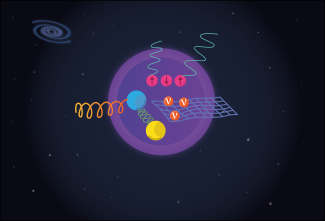
Heavy nuclei, such as gold, are thought to be synthesized in astrophysical sites such as supernovae or neutron star mergers. A key input in predicting the yields of various nuclei is provided by the fluxes of electron-type neutrinos, very light and weakly interacting particles which can morph into other ‘flavors’ of neutrinos, called muon and tau neutrinos. In this study, we present a consistent framework to study the quantum many-body neutrino dynamics, adopting for the first time the complete neutrino-neutrino interaction derived from the Standard Model.

In explosive astrophysical sites such as supernovae and neutron star mergers, due to high density, neutrino self-interactions cannot be neglected. The traditional kinetic theory approach has been recently challenged by quantum many-body studies, that however have used a severely limited set of interactions. By implementing the complete neutrino self-interaction for the first time, we study the thermalization of neutrino momenta, a new qualitative phenomenon compared to previous studies, and the shortening of the time scale for randomization of neutrino flavor.

This work opens the way to future studies in several directions. Most importantly, simulations of systems with a larger number of neutrinos with state-of-art many-body methods using classical or quantum computers are required for two reasons. First, such large-scale simulations will allow us to compare the kinetic and quantum many-body approaches. Second, such full neutrino dynamics simulation can provide valuable insights into studies of nucleosynthesis and evolution of dense astrophysical objects.

Image
Talk 1

The "Chiral EFT: New Perspectives" workshop takes place March 17-21, 2025. Visit the workshop webpage for more information on the event.

Image
Tomassoni Prize

David Kaplan (Institute for Nuclear Theory) has been awarded the Caterina Tomassoni and Felice Pietro Chisesi Prize in Physics. Professor Kaplan is recognized for introducing the domain wall method for simulating chiral fermions on the lattice and for seminal work on other strongly interacting systems. 


Image
PECASE2025

Nuclear Theorists Raúl Briceño (pictured right) and Zohreh Davoudi (pictured left) receive the Presidential Early Career Award for Scientists and Engineers (PECASE), the highest honor bestowed by the U.S. government on outstanding scientists and engineers early in their careers.

Click here for more information on the award!

Image
APS 2025 Awards

Professors Dick Furnstahl (The Ohio State University; pictured right) and Baha Balantekin (University of Wisconsin-Madison; pictured left) have been awarded the 2025 APS Herman Feshbach and Hans A. Bethe Prizes, respectively!  

The Herman Feshbach Prize  serves to recognize and encourage outstanding research in theoretical nuclear physics.

The Hans A. Bethe Prize serves to recognize outstanding work in theory, experiment or observation in the areas of astrophysics, nuclear physics, nuclear astrophysics, or closely related fields.